
June 10, 2026
Hip-Hop as Healing: Graduate Students Advance New Therapy Research
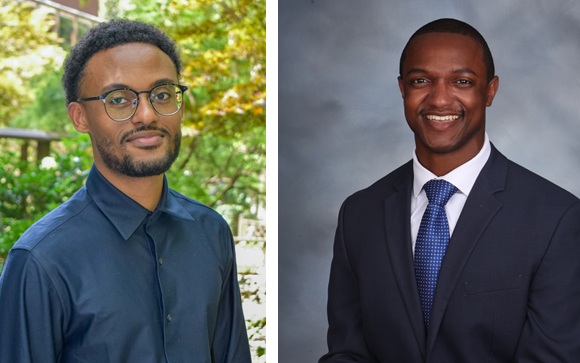
Yohannes Girma and Caleb Floyd, third-year graduate students in the Mental Health Counseling master’s program, are advancing emerging research that positions hip-hop as a powerful tool in modern mental health treatment. Their work explores how elements of hip-hop culture — particularly freestyle rap — can unlock new pathways for emotional expression, self-reflection and therapeutic engagement.
Building on foundational work introduced by psychologist and hip-hop therapy pioneer Edgar Tyson in 1998, Girma and Floyd examine how rap, dance and storytelling translate into clinical practice. Their research focuses specifically on freestyle rap, identifying it as an underutilized therapeutic technique that encourages spontaneous, unfiltered expression.
Through their findings, Girma and Floyd highlight freestyle rap’s ability to help individuals articulate deeply personal experiences in ways that traditional talk therapy may not. Their research suggests that the improvisational nature of the practice fosters authenticity, lowers emotional barriers and creates a cathartic outlet for processing trauma and identity.
Their work contributes to a growing body of research that recognizes culturally responsive approaches as critical to effective mental health care, particularly for underrepresented and marginalized communities.
Girma and Floyd credit Bowie State with shaping their research lens and commitment to this work. Both students previously attended predominantly white institutions and say that studying at an HBCU has strengthened their focus on equity in mental health care.
Girma noted that the supportive environment has allowed him to grow both personally and academically.
“This is a space where most people look like me. We all have biases, but not having to face microaggressions based on race helped me learn and grow.”
Floyd emphasized the role of faculty mentorship in refining both his research interests and professional path.
“In comparison to my undergraduate experience, professors here speak to me as a Black man about how to navigate the world. Faculty pour into students so they can give back to the community.”
As they prepare to present their research at the Association of Black Psychologists Conference, scheduled for July 28–Aug. 1 at Morgan State University, Girma and Floyd aim to expand the conversation around innovative, culturally grounded therapies.
Their work reflects Bowie State University’s commitment to preparing future licensed professional counselors who can adapt their approaches to meet the diverse needs of the communities they serve.