

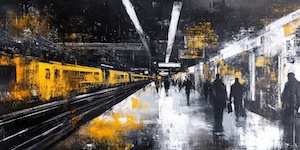
And So, She Wears Gray
By Taylor Johnson
Time—time does not wait. It sheds itself in leaves and frost while I remain unmoved, mistaking paralysis for patience.
If I chose disappearance—not loud, not heroic, just a quiet undoing—would anything shift? If I let something dull and indifferent persuade my veins to open like unwilling mouths, if I watched my life thin into slow, deliberate threads—would the world hesitate? Or would it take me in without notice, as if I were always meant to be forgotten?
“Next stop: Capital South.”
The announcement cuts clean through thought. The car shuddered to an acceptable halt, swaying the palette of neatly pressed black-, gray-, and white-suited bodies bending to the will of an oiled machine.
I gather my belongings, straighten the seams of my own gray suit, and step forward with the other suited patrons—inch by inch toward the doors. They open with a mechanical sigh, as if the train itself has grown tired of holding caskets of ghosts.
The swell of shadows spilled onto the concrete platform, calibrated for arrival. I step out, indistinguishable, absorbed into the surge of bodies pressing forward toward the Metro exit. Every movement measured. A part of an unspoken choreography of survival: breathe here, walk there, exist nowhere—just convincingly enough to not be questioned. And somewhere between the platform and the steps, I almost disappear completely—not by leaving, but by staying.
Shoes strike pavement in steady, indifferent rhythms—a language spoken without thinking. Engineered to maintain progress, routine. But before I can drift toward the exit doors, a sound sifts through the dull hum of the station—a beat, steady and insistent, tapping against my ear with familiarity.
Drums. Or something close to it.
When my eyes finally find the source, tucked into a corner—sticks in hand, playing against an old metal bench. The surface dent, worn thin, but she makes it answer anyway. Each strike pulls a rhythm out of something that was never meant to sing.
It’s rough. Off-beat in places. But alive.
I recognize it after a moment—a fractured, stubborn version of “Man in the Mirror.” Not quite right, not quite whole. The melody bends under her hands, reshaped into something else entirely.
Something closer. More akin to a staccatoed “woman in the mirror.”
The sticks blur as she plays, carving sound out of silence, insisting on being heard in a space built to ignore. And for a moment, the station is no longer a throughway—no longer something to endure on the way to somewhere else. It becomes a place holding something that refuses to disappear even in a crowd.
Before I realized it, I had stopped—frozen mid-step—drawn in by the sound.
Could no one else hear it the way I did? See what I was seeing? People passed without pause, without notice, as if the moment wasn’t happening at all. After a while, she looked up—maybe sensing it, that quiet instinct women carry, the awareness of being watched by eyes that are unsourced, uncited, unvetted. Calculating whether to risk a glance or offer a smile that might be mistaken for an invitation.
Her eyes found mine in the crowd.
And only then did she smile.
Not for attention or for approval. Just a loose, unburdened smile—free in a way that didn’t ask permission to exist. It felt like something passed between us. I wondered if she felt it too—that quiet kinship. The type of camaraderie only a fellow-hued stranger who understood the cost of being unclaimed could offer, to be seen, but not recognized, like a scream never realized.
You learn quickly: not every place yields sand. Some give you stones and boulders where you expected something soft. We sift through it anyway, shaping what we can, discarding what we can’t, curating something presentable for the world. A collection of surfaces.
But underneath—we are all rotting toward the same end. The difference is not in the decay—
only in how well we learn to hide it. So, we smile, almost.