
Sept. 29, 2026
For Maggy Francois, Investing in Bowie State Students Starts with Betting on Herself
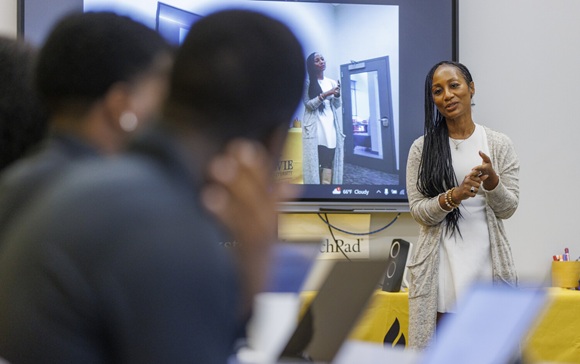
A few years ago, Maggy Francois worked with a TV executive on a single commercial shoot, putting her Bowie State fashion design students behind the scenes on set. This summer, when Francois needed support for a campus Welcome Week event, she made one phone call to that TV executive. The executive remembered the students from that shoot and didn’t hesitate, saying she wanted to invest in Bowie State University.
That’s how Francois works, and it’s why the university keeps giving her more room to work. She holds three positions at Bowie State: adjunct professor in the Department of Fine & Performing Arts, marketing consultant for the Entrepreneurship Innovation Center and executive-in-residence.
Francois has taught for 29 years, the last 11 at Bowie State. She arrived in Maryland from New York in the mid-1990s and discovered, almost by accident, the culture of a historically Black university.
Francois teaches self-promotion and marketing, fashion design and costume design. She tells her students the same thing she tells herself when an industry shifts beneath her: bet on yourself.
“Educate yourself, believe in your own work and be willing to make the case for it, because no one else will make it for you,” she said.
Her advice grows out of relationships. The connections she built during her career while planning events for the Congressional Black Caucus and behind the scenes as a costume designer and a casting director for feature films, commercials and music videos are the same ones she now leans on to bring opportunities, internships and investment back to campus.
The stakes of her advice became clear to her years ago, when a former student, whom she had taught fashion design in Fairfax County, told a national TV audience that fashion had saved his life. He had grown up around crime and poverty and had twice come close to losing his own life. He credited a teacher with changing his path by showing him an industry he could belong to.
Francois still thinks about that student’s story when she talks about why her work matters.
“It’s not really about clothes. It’s about giving young people a reason to see themselves differently,” she says.
That same instinct drives Francois’ work at the Entrepreneurship Innovation Center, one of the university’s most dynamic spaces for student creativity. Her role there is about connection: helping the center capture students’ attention, amplifying the stories of emerging founders and turning entrepreneurship into something students can envision themselves pursuing.
Through creative marketing, storytelling and student engagement, Francois brings visibility and energy to a center that has reached thousands of students and supported more than 150 student ventures. Whether spotlighting a student founder, promoting a major event or helping students discover resources to move an idea forward, she helps make entrepreneurship visible, exciting and accessible across campus.
For Francois, marketing is more than promotion. It’s a tool for helping students see possibility in themselves and giving their ideas a platform. Students arrive with an idea, she said, and leave seeing an opportunity.
One recent success is a student-designed card game focused on mental health that has won multiple pitch competitions and is now making its way into bookstores. Francois calls it “evidence of what happens when students are given room to build.”
She measures her own success one relationship at a time. She doesn’t need a headline number to know she has made a difference. If her work reaches one student, or two, or a handful who go on to build something of their own, that is enough.
Asked to describe Bowie State in a single line, she did not reach for statistics or rankings. She calls it a place where you can create, build and inspire.
“That is Bowie Bold,” Francois said. “Taking the risk, building the relationship and betting on the people around you to make good on it.”