
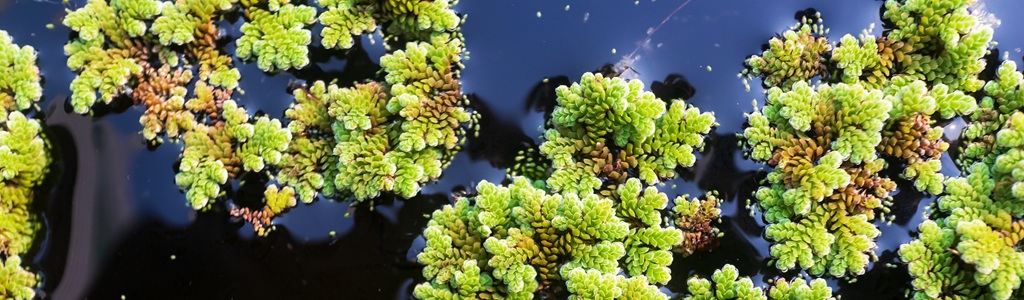
Azolla pinnata
Global Research Experiences
Bioprospecting Underutilized Aquatic Plants for Food Production Systems
- Mentor Professor: Oscar Donde, PhD
- Graduate Mentors: Kavin Otieno and Peter Opunyo
- Location: Egerton University, Kenya
- Contact: oscar.donde@egerton.ac.ke | +254 725.8674.78
The sustainability of aquaculture systems, particularly aquaponics, continues to be constrained by the high cost of commercial feeds and the limited availability of locally adapted functional additives such as probiotics. Probiotic bacteria, especially lactic acid bacteria (LAB) isolated using MRS agar, are well documented for their role in enhancing fish gut health, improving nutrient utilization, and increasing resistance to diseases. Underutilized aquatic plants such as Azolla pinnata, Lemna minor, and Arthrospira platensis are promising low-cost resources for sustainable aquaculture. A. pinnata is abundant in local aquatic ecosystems and is rich in proteins, essential amino acids, vitamins, and minerals. Importantly, it also harbors diverse microbial communities, including potential probiotic LAB. Fermentation has been shown to significantly influence microbial composition and diversity, potentially enhancing the abundance and functionality of beneficial bacteria. However, there is limited systematic research evaluating how different fermentation approaches; spontaneous, enrichment, and solid-state fermentation, affect the isolation, diversity, and probiotic potential of LAB from A. pinnata.
This study therefore focuses on harnessing A. pinnata as a locally available substrate to isolate and characterize probiotic LAB strains using MRS agar under different fermentation conditions. The outcomes will contribute to the development of cost-effective, locally sourced probiotic candidates for aquaponic fish feed applications. The study aims to isolate, evaluate, and molecularly characterize probiotic LAB from A. pinnata obtained from different ecosystems under spontaneous, enrichment, and solid-state fermentation methods for potential application in aquaponic fish feed formulation.
Research Questions
- Does the underutilized aquatic plants host probiotic lactobacillus species appropriate for fish feed formulation?
- Do the sampling location/ecosystem/growth conditions influence the type and quality of probiotic lactobacillus species?
- What is the appropriate fermentation procedure for effective isolation of probiotic LAB species?
- What are the probiotic properties exhibited by lactobacillus species from different plants and isolated through different fermentation methods?
- Do the different underutilized aquatic plants host different species of probiotic LAB?
- What are the benefits of probiotic lactobacillus formulated fish feed in aquaponic production systems?
2026 Work Package
Objective 1 (Student 1)
To isolate and identify Lactic Acid producing bacteria from Azolla pinnata from different ecosystems through Spontaneous fermentation
Activities
- Sampling of the Azolla pinnata plants from different ecosystems - Done from Egerton University
- Subjecting the plant samples to Spontaneous fermentation - Done at Egerton University
- Isolating the probiotic Lactic Acid Bacteria (LAB) from the fermented plant - Done at Egerton University
- Testing for probiotic properties of the isolated LAB - Done partly at Egerton University and Partly at ILRI
- Isolating and sequencing probiotic LAB DNA - Done at ILRI
Objective 2 (Student 2)
To isolate and identify Lactic Acid producing bacteria from Azolla pinnata from different ecosystems through Enrichment Fermentation
Activities
- Sampling of the Azolla pinnata plants from different ecosystems- Done from Egerton University
- Subjecting the plant samples to enrichment fermentation - Done at Egerton University
- Isolating the probiotic Lactic Acid Bacteria (LAB) from the fermented plant - Done at Egerton University
- Testing for probiotic properties of the isolated LAB - Done partly at Egerton University and Partly at ILRI
- DNA isolation and sequencing of the probiotic LAB - Done at ILRI
- Probiotic isolation, purification, identification and mass culture
For probiotic isolation, bacteriological media [Nutrient agar, MacConkey agar, Potato Dextrose Agar (PDA), de Man, Rogosa and Sharpe agar (MRS), Mannitol Salt Agar (MSA), Thiosulfate-citrate-bile salts-sucrose agar (TCBS) and Blood agar] will be prepared according to manufacturer’s instructions (Sigma-Aldrich, USA). The media will be sterilized at 121°C for 15 min in an autoclave and later poured into sterilized disposable plastic petri dishes. The petri dishes will then be stored in the incubator after media drying. To obtain bacterial cells from the fish, swab samples will be taken from the internal organs (stomach, and intestine); they will be cultured on tryptic soya broth (TSB) and incubated at 30°C for 1 to 2 days. Bacterial culturing will then follow the method as described by Boone et al. (2001). Briefly, a quantity of 0.1mL/recommended dilutions will be inoculated in Petri dishes of Nutrient Agar, MacConkey agar, TCB, PDA, MSA agar plates in duplicates and spread using a sterile glass rod, then incubated aerobically for 24 to 48 h at 37°C and anaerobically for MRS agar plates at the same temperature and hours.
Each distinct colony will further be sub cultured on freshly prepared Nutrient agar for evaluation of purity and colonial morphology. The isolates will be further subjected to Gram stain to determine their Gram reaction and biochemical test as described by (Cheesbrough, 2006) and (Mac Faddin, 1976) and also, to determine the identity of bacteria isolates. Further molecular identification of the bacterial isolates will be undertaken through DNA isolation and sequencing at a sequencing company to be identified. Specifically, this will involve pour plate technique where aseptic technique will be maintained at all stages. Random selection of the representative colonies from each plate (10 colonies/plate) will be done and subjected to PCR using Primers appropriate primers (27F: 5-GAGTTTGATCCTGGCTCAG-3 and 1492R: 5- GGTTACCTTACGACTT-3) to amplify 16S rRNA gene. PCR amplification will be performed using a 20 µL reaction volumes containing 9 µL iTaq universal SYBR Green Supermix (Bio-Rad, America), 9 µL double distilled water, 1 µL of both forwards and reverse primers and template inoculated using sterilized toothpick tip. PCR will be undertaken under the following conditions: 34 cycles at 94 ˚C for time of 5 minutes, 94 ˚C for time of 60 seconds, 55 ˚C for time of 60 seconds and 72 ˚C for 2 minutes (Wang et al., 2009; Li et al., 2014). Amplification specificity test will be done using 1% Agarose gel electrophoresis. Sequencing of the positive PCR products will then be undertaken.
Analysis of the 16S rRNA gene sequences from selected colonies will be done using Basic Local Alignment Search Tool (BLAST) at the National Centre for Biotechnology Information (NCBI) website. Presumptively identification of the isolate will be done according to the identity of the closest cultured relative in the top BLAST hits. The 16S rRNA gene sequences of all the selected colonies and their closest reference sequences will be used in the phylogenetic analysis through Mega 5 software package (Li et al., 2014). The alignment of the sequences will be done using the positional tree server with a data set containing the nearest relative matches. The neighbor joining algorithm will be used in constructing the phylogenetic Trees. The isolates identified under Lactobacillus spp and Lactococcus spp will further be subjected to mass production under Nutrient agar and availed for test probiotic tests in the tilapia culture experimental ponds.